Currency

Are you over 18 years old?
Please confirm you are 18+ years old, and that using offered products is legal in your country.
Please confirm you are 18+ years old, and that using offered products is legal in your country.
 585-842-7333
 249-438-7333
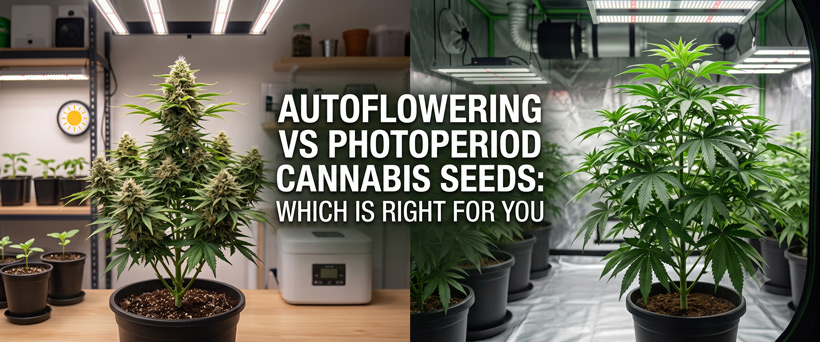
One of the first decisions every grower faces is whether to choose autoflowering or photoperiod cannabis seeds. If you've been researching cannabis genetics, you've probably come across the debate: autoflower vs photoperiod.
Both types can produce excellent results, but they grow differently and are suited to different goals. For some growers, speed and simplicity matter most. For others, maximizing yield and controlling every stage of growth is the priority.
Understanding the differences between autoflower and photoperiod cannabis seeds can help you choose the right genetics for your growing space, experience level, and timeline.
Autoflowering cannabis plants are unique because they begin flowering automatically as they mature. Unlike traditional cannabis plants, they do not require changes to their light cycle to trigger flowering.
This characteristic comes from Cannabis ruderalis, a subspecies of cannabis that evolved in northern regions with short growing seasons and long summer daylight hours. Unlike indica and sativa plants, ruderalis adapted to flower based on age rather than changes in daylight.
Modern autoflowering seeds combine ruderalis genetics with popular indica and sativa cultivars. The result is a plant that offers many of the flavour, potency, and growth characteristics growers want while retaining the automatic flowering trait.
Most autoflower plants complete their entire lifecycle in roughly eight to twelve weeks from seed, making them one of the fastest-growing cannabis options available.
For growers looking for a quick harvest, limited grow space, or a straightforward growing experience, autoflower seeds Canada growers purchase are often an attractive choice.
Photoperiod cannabis plants follow a more traditional growth cycle. Instead of flowering automatically, they remain in the vegetative stage until they receive the appropriate amount of darkness each day.
Indoors, growers typically maintain eighteen hours of light and six hours of darkness during vegetative growth. When they are ready to begin flowering, they switch to a twelve-hours-on, twelve-hours-off light schedule.
Outdoors, photoperiod plants rely on seasonal daylight changes. As summer transitions into fall and days become shorter, the plants naturally begin flowering.
This system gives growers considerably more control over plant development. A photoperiod plant can remain in vegetative growth for weeks or even months before flowering begins, allowing it to grow larger and develop a stronger structure.
For growers comparing autoflower vs photoperiod seeds, the biggest advantage of photoperiod genetics is control. For growers focused on maximizing yield, photoperiod seeds remain the preferred choice.
When comparing autoflower vs photoperiod, yield and growing time are often the deciding factors.
Autoflowers generally grow smaller than photoperiod plants and finish much faster. Because they move into flowering automatically, growers have less time to influence plant size before buds begin developing.
This shorter lifecycle can be a significant advantage. Indoor growers can complete more harvests per year, while outdoor growers may be able to fit multiple growing cycles into a single season.
Photoperiod plants, however, usually have greater yield potential. Since growers control the length of the vegetative stage, plants can be trained, shaped, and grown significantly larger before flowering begins.
The trade-off is time. A photoperiod grow often requires several additional weeks compared to an autoflower grow. While the final harvest may be larger, patience is required.
In simple terms, autoflowers tend to prioritize speed, while photoperiods prioritize size and yield.
| Feature | Autoflower | Photoperiod |
| Flowering Trigger | Age | Light cycle |
| Typical Grow Time | 8-12 weeks | 12-20+ weeks |
| Plant Size | Smaller | Larger |
| Yield Potential | Moderate | Higher |
| Training Flexibility | Limited | Extensive |
| Best For | Fast harvests and small spaces | Maximum yield and control |
| Outdoor Canada | Excellent for short seasons | Best in longer growing seasons |
Many new growers wonder whether autoflower or photoperiod seeds are easier to grow.
The answer depends on what aspect of growing feels most challenging.
Autoflowering plants eliminate the need to manage flowering light schedules. This makes them appealing to beginners who want a simpler growing process. Once planted, the plant largely follows its own timeline.
However, autoflowers can be less forgiving when problems occur. Because they have a fixed lifespan, mistakes made during the seedling or early vegetative stages can affect final yields. There is often limited time for recovery.
Photoperiod plants require more attention to lighting schedules, but they provide greater flexibility. If a plant experiences stress or nutrient issues during vegetative growth, growers can often extend that stage and allow the plant additional time to recover.
For this reason, some experienced growers actually consider photoperiod plants easier to manage over the long term despite the added complexity of light scheduling.
Climate is one of the most important considerations for Canadian growers.
In many parts of Canada, the outdoor growing season is shorter than in warmer regions of the United States. Early autumn rain, cool temperatures, and increased humidity can create challenges for plants that require a long flowering period.
This is one reason autoflower seeds Canada growers purchase have become increasingly popular. Their rapid lifecycle allows many strains to finish before autumn weather becomes a serious concern.
Growers in Ontario, Quebec, Atlantic Canada, and northern regions often appreciate the ability to harvest before frost risk increases. Autoflowers can also reduce exposure to mould and bud rot during wet fall conditions.
Photoperiod plants can still perform exceptionally well outdoors in Canada, particularly in Southern Ontario and parts of British Columbia. However, strain selection becomes more important. Fast-finishing genetics are often preferred to ensure plants complete flowering before adverse weather arrives.
For growers dealing with short seasons, autoflowers frequently provide the safest path to a successful harvest.
When comparing autoflower vs photoperiod, there is no universal winner. The best choice depends entirely on your goals.
If you want the fastest possible harvest, have limited growing space, or prefer a straightforward growing experience, autoflower seeds are often the better option. Their automatic flowering cycle and compact size make them well suited to small indoor grows and short outdoor seasons.
If your goal is maximum yield, larger plants, and complete control over training techniques, photoperiod seeds usually offer greater flexibility. They allow growers to shape plant structure, extend vegetative growth, and optimize production before flowering begins.
Many growers eventually experiment with both types. The good news is that neither choice is wrong. Both autoflower and photoperiod genetics can produce exceptional results when matched to the right growing environment and expectations.
The debate around autoflower vs photoperiod isn't about which type is better. It's about which type is better for you.
Autoflowers offer speed, simplicity, and reliability in shorter growing seasons. Photoperiod plants provide greater control, larger harvest potential, and more opportunities for advanced growing techniques.
For Canadian growers purchasing their first or second set of seeds, understanding these differences can make strain selection far easier. By matching your genetics to your space, climate, and goals, you'll be in a much better position to enjoy a successful and rewarding grow.