Currency

Are you over 18 years old?
Please confirm you are 18+ years old, and that using offered products is legal in your country.
Please confirm you are 18+ years old, and that using offered products is legal in your country.
 585-842-7333
 249-438-7333

Navigating an online seed bank catalog can initially feel like deciphering a complex technical manual.
With abbreviations such as "Fem," "Auto," "F1," and "IBL" listed alongside detailed genetic lineages and profile descriptions, product pages contain a wealth of information.
For collectors, preservationists, and legal buyers, knowing how to interpret a cannabis seed listing is the key to making informed decisions. This guide breaks down the standard components of a seed product page, explains common seed terminology, and offers practical tips for comparing documented breeder details.
One of the most critical elements of any seed listing is the breeder identity. A seed's lineage tells you about its genetic heritage—specifically, which parent strains were cross-bred to create the seed line.
Reputable seed banks organize listings primarily by breeder. Established breeding houses spend years stabilizing specific genetic traits, resulting in detailed documentation for their catalog offerings. When evaluating a listing, verify that the breeder is clearly named rather than listed under a generic label. Exploring dedicated collections, such as the curated catalog of Canuk Seeds at True North Seed Bank, provides a clear view of verified breeder documentation and standardized strain descriptions.
Strain listings typically format genetic origin using a standard cross notation (`Parent A x Parent B`).
Understanding lineage helps buyers evaluate historical genetic backgrounds, whether a strain traces back to classic landrace origins or modern hybrid lines.
Cannabis seed listings categorize products into specific seed formats. Recognizing these designations ensures you know exactly what format is included in the package.
Regular seeds are produced naturally by crossing a female plant with a male plant. As a result, regular seed listings represent offspring that have a roughly equal probability of developing into male or female plants. Breeders and collectors often prefer regular seeds for genetic preservation and selecting breeding stock.
Feminized seed listings indicate that the seeds were produced using specific breeding methods designed to eliminate male chromosomes. Listings marked as feminized generally result in female plants almost exclusively (typically 99% probability), eliminating the need to identify and remove male plants during growth.
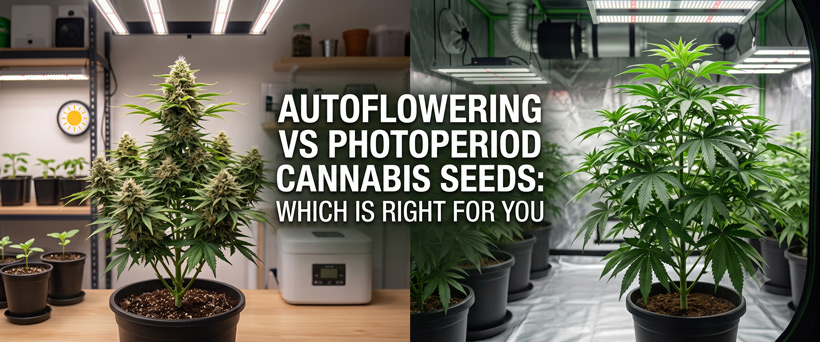
Autoflowering listings denote seeds bred with *Cannabis ruderalis* genetics. Unlike standard photoperiod seeds—which rely on changes in daily light cycles to transition between growth phases—autoflowering strains transition based on genetic age. Autoflowering listings can feature either regular or feminized options, though most commercial auto listings are feminized.
Most seed listings highlight the species background as a percentage breakdown or general classification:
Seed listings contain specific metrics documented by the breeder. It is important to view these figures as genetic estimates recorded under controlled testing conditions rather than absolute guarantees.
Listings often provide percentage ranges for primary cannabinoids such as THC and CBD. These percentages represent baseline lab measurements reported by the breeder for healthy, fully mature samples of that strain line. Ranges (e.g., 18%–22% THC) reflect normal genetic variation between individual seeds.
Listings for photoperiod strains often state an estimated "Flowering Time" (usually given in weeks, such as 8–9 weeks), while autoflowering listings often state a total "Life Cycle" time (e.g., 65–75 days from seed to maturity). These figures reflect breeder observations and serve as useful benchmarks for comparing relative growth speeds between strains.
Breeder listings frequently include yield categories (e.g., Low, Medium, High, or specific gram estimates per square meter). These listings reflect output potential recorded by the breeder in optimized environments and should be used strictly for comparison between different strains under similar conditions.
Advanced seed listings may include technical codes describing how many generations a seed line has been bred or stabilized:
Finally, always examine the pack size options on a listing page. Seed banks distribute products in verified breeder-sealed packaging to protect seed integrity and confirm authenticity. Common pack sizes include:
When reviewing a listing, ensure the chosen pack size matches the intended seed quantity before adding it to your order.
Reading a cannabis seed listing effectively comes down to understanding the technical details provided by the breeder. By learning how to read lineage notation, seed classifications, chemical profile ranges, and generational codes, you can evaluate online catalogs with clarity and precision. Always rely on documented product information from verified distributors to ensure authentic genetics and predictable characteristics.